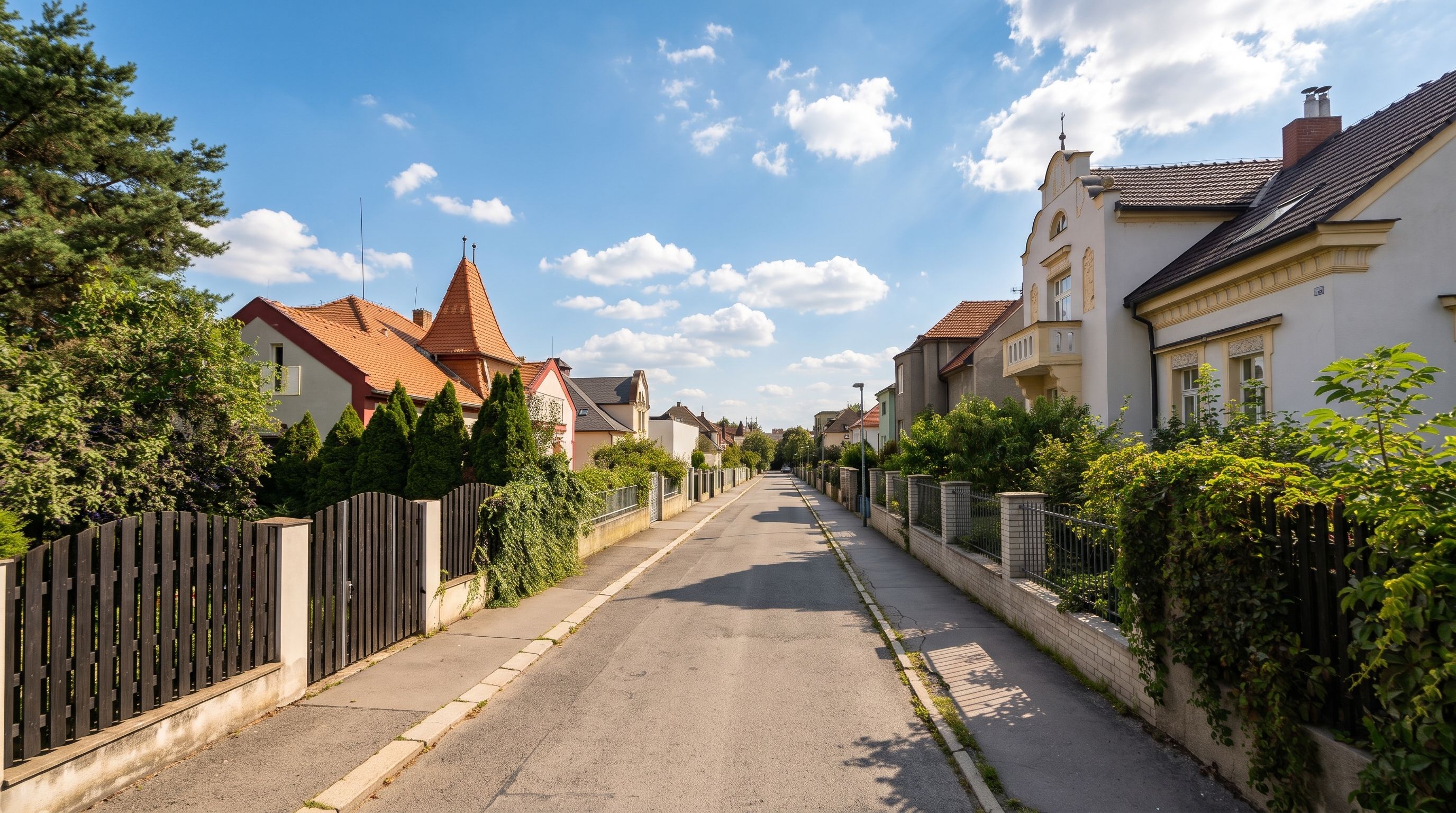
Strašnice, the Prague 10 district east of Vinohrady, is a textbook of 20th-century Prague housing in one place. Within about two kilometres you can walk past villas from 1902, cooperative colonies from the 1920s, Solidarita (Prague's first post-war housing estate, built as rows of small houses with gardens), prefab blocks from the 1960s and 1970s, and a brand-new district by the metro. Each one is a different way to live, and the type of building you choose will shape your life here more than the name Strašnice.
What it is like to live in Strašnice
Strašnice is a quiet residential district on metro line A, about ten minutes from the centre. It had 37,665 residents at the 2021 census. Almost all of it belongs to Prague 10; a small industrial strip near Žižkov belongs to Prague 3. Until the late 19th century it was a village known for growing cabbage. When it became part of Prague in 1922 it had 4,800 residents, and by 1934 it had 20,000. Most of what you see today was built over the following decades, one layer at a time.
There is no main square. Locals treat Starostrašnická street and the area around Strašnická metro station as the centre. The streets are lower and greener than in the inner districts: villas with gardens, three- and four-storey apartment buildings, and taller prefab estates further east. Evenings are quiet. There are local restaurants, a district cultural centre and two small theatres. People move here for a calm home.
Strašnice is also cheaper than its neighbours. In our view, when you buy in Strašnice you should almost always pay less than in Vinohrady, which is a much more premium district, and usually less than in Vršovice for a building of the same quality. Some parts of Strašnice have better transport than Vršovice, though, so where exactly you buy makes a big difference.
The parts of Strašnice
In our experience Strašnice falls into five parts, plus Zahradní Město to the south, which most people count as Strašnice even though it officially belongs to Záběhlice. The everyday centre is around Strašnická metro station. The most premium part is Hagibor on the western edge, because it is mostly new and much closer to the city centre than the rest.
Old Strašnice around Strašnická metro
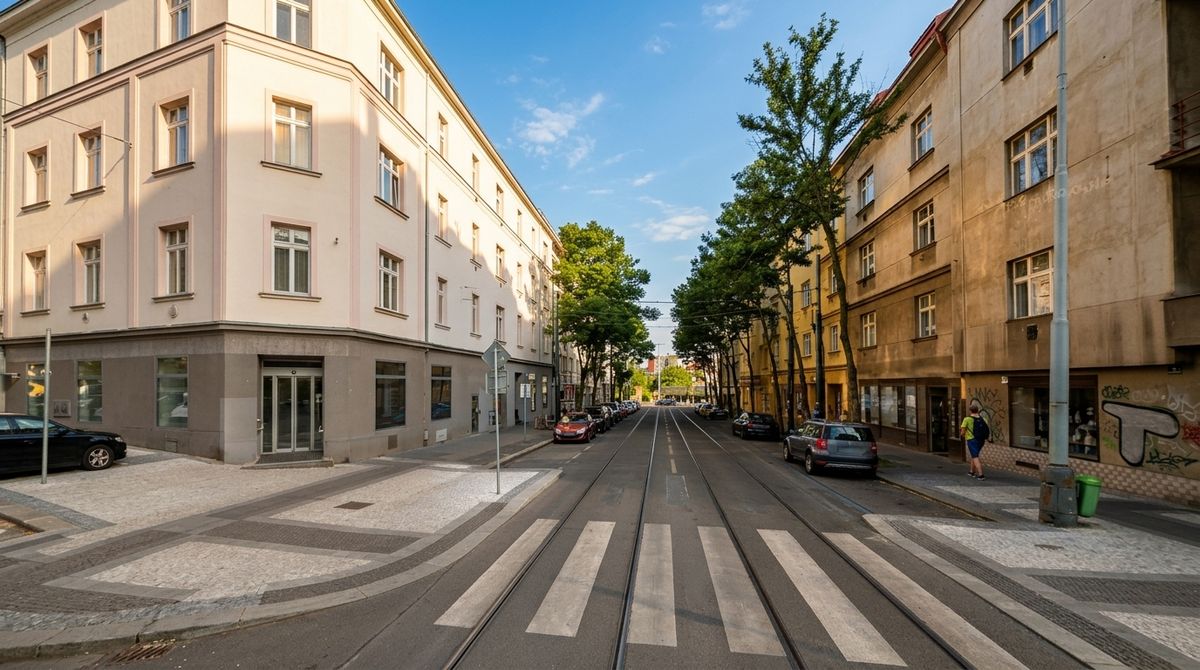
The streets around Starostrašnická, V Olšinách, Průběžná and Dubečská have the shops, services, the metro and several tram lines. Most buildings date from the early 20th century and the interwar years, with small 1950s estates in between. The Strašnice tram depot, opened in 1908, is the oldest in Prague that is still in use. Three minutes from the metro is Gutovka, a free sports park with the largest outdoor climbing wall in Central Europe, a skatepark, beach-volleyball courts, a water play area and a playground. The catch is traffic: V Olšinách, Průběžná and the roads around the station are busy, and a flat facing them is a very different place to live from one a street away.
The villa streets and Třebešín
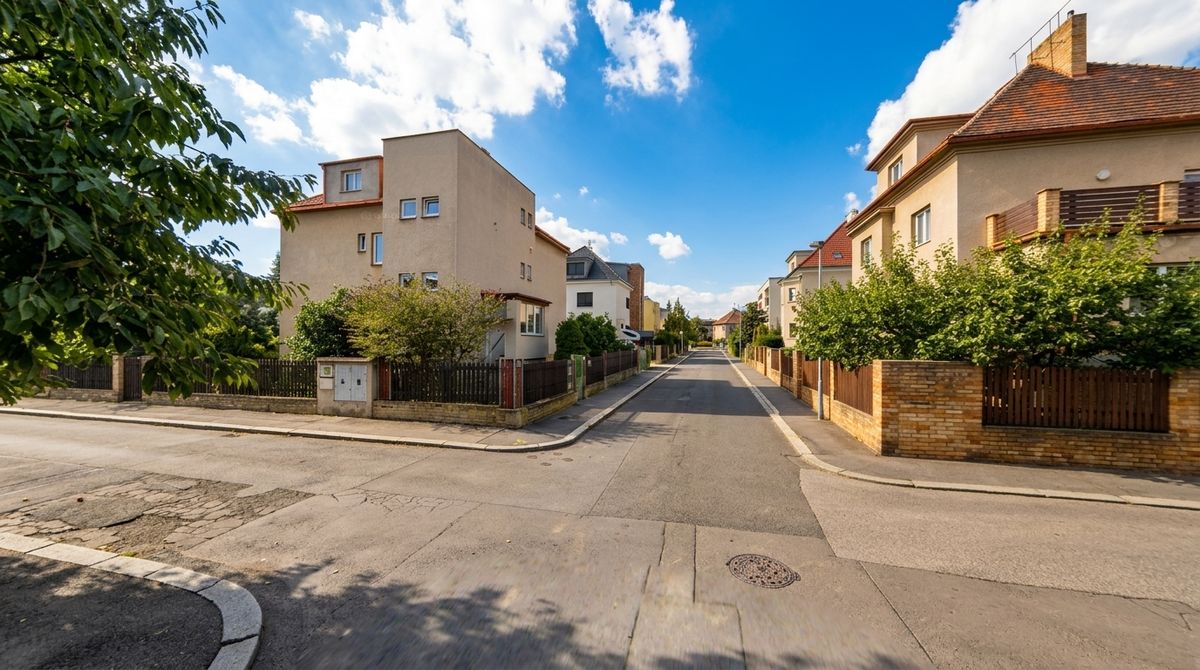
Strašnice has one of the oldest villa quarters in Prague. It began in 1902 with four villas on Vilová street, one of them designed by the architect Jan Kotěra and now a protected monument. The streets around it, such as Nad Olšinami, Na Vinici and Ve Stínu, are lined with villas from the early 20th century and the interwar years. North of Počernická, Třebešín is a hill of villas from the 1920s and 1930s, with a small park and a concrete cycling track from 1941 that now also has a pump track. These are the greenest and quietest streets in Strašnice. The villas are also expensive, and many of them have not been well maintained, so each one has to be judged on its own.
Solidarita
Between Černokostelecká and V Olšinách lies Solidarita, built from 1947 as Prague's first post-war housing estate. Most of it is about 600 two-storey row houses, each 4.5 metres wide with a small garden at the back, set in long rows around a green strip with a school, a sports ground and a theatre from 1961. The northern part of the park in the middle, Park Na Solidaritě, was renovated in 2023. Living here means a small house with a garden ten minutes by metro from the centre, which is rare in Prague. The houses are narrow, have no cellars and rarely come up for sale.
Skalka and Rybníčky
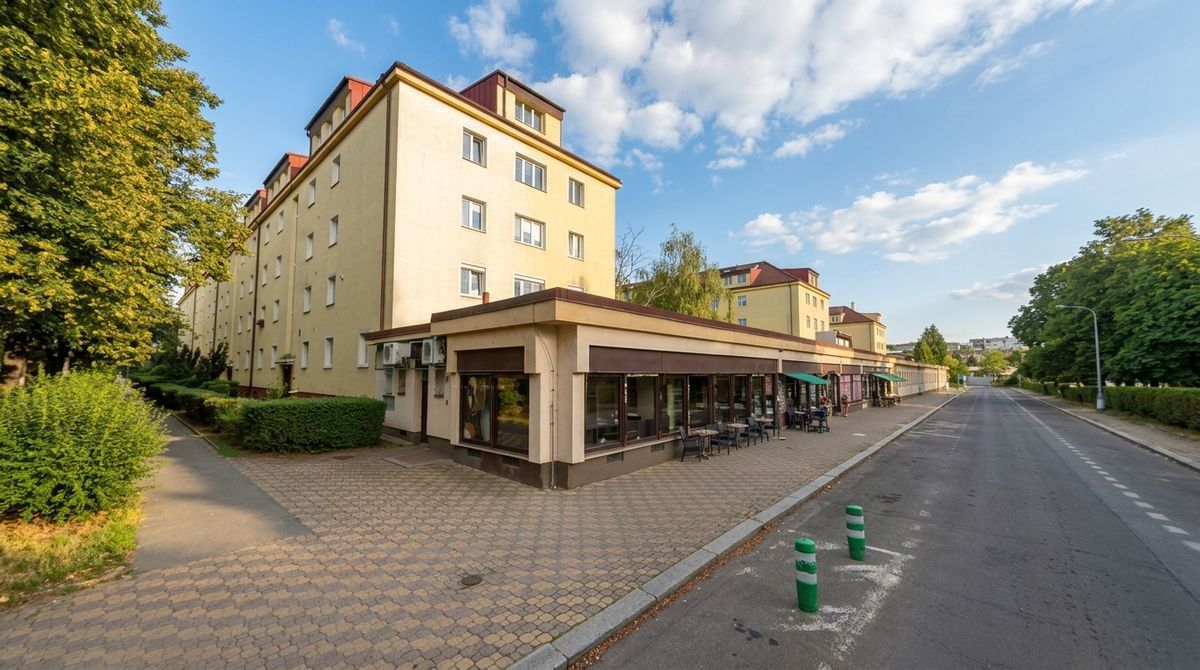
Around Skalka metro station are two housing estates: Rybníčky, built from 1958 to 1960 with about 1,050 flats, and Skalka, built from 1967 into the mid-1970s with about 1,780 flats in prefab blocks. Next to the station there is a shopping centre with a hypermarket and buses to the eastern suburbs. These are usually the most practical and the cheapest flats in Strašnice, with green space between the blocks and lifts in the taller buildings. The catch is the Jižní spojka, a ring road that runs along the southern edge of Skalka and carries roughly 90,000 to 124,000 vehicles a day.
Hagibor and the western edge by Želivského
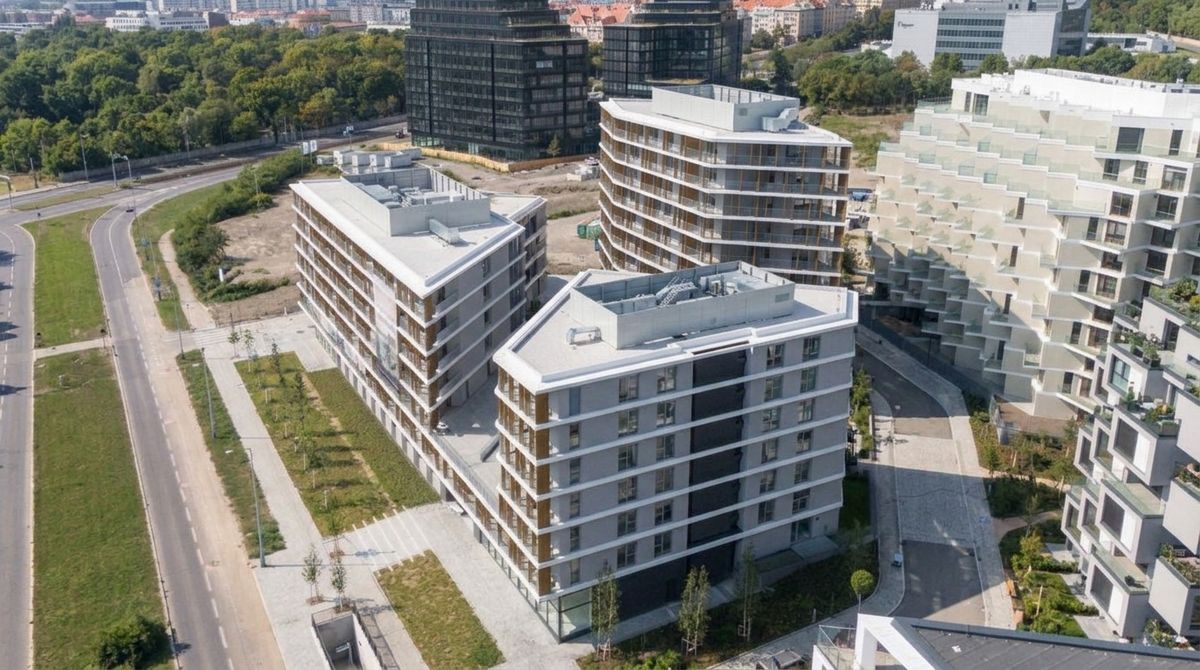
The western tip of Strašnice, by Želivského metro station on the border with Vinohrady and Žižkov, is its most premium part. A new district called Hagibor is being built here on a former brownfield site. The first residents moved in in 2022, four apartment buildings are finished (one of them entirely rental flats), and the fifth, with about 250 flats, is under construction and due in 2028. There is already a supermarket, restaurants and a pedestrian street leading to the metro, with office buildings around it and a two-hectare park planned. Across Počernická stands an older residential and office complex from 1999 to 2003. Hagibor is not cheap, and whether you like the new district is a personal matter, so walk through it before you decide.
Zahradní Město (officially part of Záběhlice)
South of Průběžná, Zahradní Město ("Garden Town") began in 1928 as a cooperative colony of family houses, and by 1941 almost 600 had been built, on streets named after flowers and trees. Two large housing estates with nearly 5,000 flats were added around it in the 1960s, and a newer neighbourhood has gone up since 2005. Officially it lies in the Záběhlice cadastral area, not in Strašnice, although it is part of Prague 10 and most people treat the two as one area. It has its own railway station, opened in 2021, with trains to the main station in about ten minutes, and trams along Průběžná and Švehlova. The busy Švehlova and the Jižní spojka are its main drawbacks, and the newest part lies close to the Botič stream, so for a building there, check the city's flood map.
The rest of Strašnice is mostly not residential. The strip along the freight railway in the south-west has warehouses and workshops, and the former Jawa motorcycle factory there now houses studios for creative businesses. The far east around Depo Hostivař is industry and the metro depot. The south-west will change: a large rental project is being built on V Korytech, and the city is preparing a new district for up to about 25,000 residents on the former rail yards between Bohdalec, Slatiny and Strašnice, a project that will take decades.
If you are unsure about a particular street or building in Strašnice, get in touch. We can usually tell you straight away.
Safety
Strašnice is very safe, like practically all of Prague. Recorded crime in Prague fell by 9.3% in 2025, to 34,853 cases, its lowest level in about 15 years. Theft and burglary make up about 43% of it. The usual precautions apply here as anywhere in the city: don't leave anything visible in a parked car, and keep an eye on your bag around the busy metro stations.
Families: schools, nurseries and parks
Strašnice has six public primary schools: on Gutova, V Olšinách, Hostýnská, Olešská (on the Skalka estate) and V Rybníčkách streets, and Solidarita on Brigádníků street. Zahradní Město has two more, on Břečťanová and Švehlova. The school on V Olšinách is in an Art Nouveau building from 1909 that reopened as a primary school in September 2025, with English from the first grade. The district also has a public grammar school on Voděradská street with four-, six- and eight-year programmes.
Prague 10 had the largest shortage of primary-school places in Prague a few years ago, about 1,000 in 2022, and has been adding places since. In the 2026 enrolment every child from a school's catchment area got a place. Public schools give priority to children from their catchment area, based on the family's registered address, so if a particular school matters to you, check its catchment before you choose a flat. Nurseries work differently: the whole of Prague 10 counts as one catchment area, so you can apply to any of the district's nurseries, which have 3,148 places between them.
For outdoor time, families have Gutovka, Park Na Solidaritě, the park and the cycling track on Třebešín, and Malešický park just to the north-east, which at about 13 hectares is the largest park in Prague 10. In summer the Hostivař reservoir, with a natural swimming area, is a short bike ride away. The district is also preparing a linear park and cycle path of about four kilometres on the former railway line through Strašnice, which closed in 2020.
Prague bans drinking alcohol in public within 100 metres of playgrounds, schools and metro entrances, and Prague 10 adds several places in Strašnice and Zahradní Město to that list, including Gutovka, Park Na Solidaritě and the area around the Skalka shopping centre.
Noise and nightlife
Most of Strašnice is not noisy. None of the noise hot spots in Prague's latest noise action plan, finalised in November 2025, lies in Strašnice or Zahradní Město. The noise comes from a handful of main roads: the Jižní spojka along the southern edge, Vinohradská and its continuation Černokostelecká, Průběžná, V Olšinách and, in Zahradní Město, Švehlova, which carries about 32,000 vehicles a day. The city added a noise wall on part of the Jižní spojka in 2024 and plans more on the section towards Švehlova by 2029. Along Počernická, a new tram line is under construction until the end of 2027.
If you are buying a flat to live in, avoid the windows facing these roads. A flat one street back, or facing a courtyard, can be very quiet. The streets along the old railway line got quieter when trains stopped running there in December 2020.
Nightlife is modest: local restaurants and pubs, concerts at the district cultural centre on Barikádníků street, and two small theatres. If you want bars within walking distance, Vinohrady and Žižkov are a few metro stops away.
Getting around and parking
Strašnice has three stations on metro line A: Strašnická, Skalka and Depo Hostivař. From Strašnická it takes about nine minutes to Muzeum at the top of Wenceslas Square and about ten to Můstek; from Skalka it takes about 13 minutes to Můstek and from Depo Hostivař about 16. Most of Vršovice, by comparison, is a tram ride from the nearest metro station. Trams run along Vinohradská, Starostrašnická, V Olšinách and Průběžná, and the Zahradní Město railway station has trains to the main station in about ten minutes. The new tram line along Počernická, with six pairs of stops including Hagibor and Na Palouku, should start trial operation at the end of 2027.
All of Strašnice has been in Prague's paid parking zones since October 2020 and Zahradní Město since July 2021. In 2026 a resident with a registered address pays 1,200 Kč a year for a permit valid across Prague 10, or 600 Kč for their own zone only. In our experience parking is easier than in Vinohrady or Vršovice, especially in the villa streets and around the estates.
The buildings, and what to check before you buy
Most of the buildings in Strašnice are dated. In our view that is a bigger issue than noise: the interwar and 1950s brick buildings and the prefab blocks from the 1960s and 1970s all have their age, and what matters is how much the owners have already invested.
Strašnice and Zahradní Město lie outside Prague's heritage conservation zones, unlike Vinohrady, Žižkov and Vršovice. Only individual buildings are protected, such as Kotěra's villa on Vilová. That makes changes such as new windows, insulation or air conditioning easier. A split air-conditioning unit normally needs no building permit, but the facade is shared property, so you need the owners' association's consent, and the outdoor unit must stay within the noise limits.
Before you buy, check:
- In a prefab block: whether the building has been insulated and has new windows, the state of the lifts and balconies, and whether the risers have been replaced. Some prefab buildings from before 1990 still have asbestos in the risers or shafts.
- In an older brick building: the roof, the wiring and the water and sewage pipes, and whether there is a lift (many three- and four-storey buildings don't have one).
- In a villa: the roof, damp in the walls and cellar, the heating, and how the costs are shared if the villa is split into several flats.
- Everywhere: the minutes of the owners' association's recent meetings, how much is in the repair fund and what repairs are planned. A low monthly contribution often means the big repairs are still ahead.
New builds are the exception. They are usually well equipped, but there are only a few of them in Strašnice, and the location matters a lot: a new flat a long bus ride from the metro can make every commute tiring. In Hagibor, check what the price includes, because a parking space there is sold separately.
What it costs
In October 2026, flats in older buildings in Strašnice were listed on the largest Czech property portal at a median of about CZK 152,000 per m², against about 163,000 in Vršovice, 198,000 in Vinohrady and 159,000 for Prague as a whole. In Záběhlice, which includes Zahradní Město, the median was about 139,000. New-build flats in Strašnice were listed at a median of about CZK 210,000 per m², and the developer's own price list for Hagibor ranged from about CZK 206,000 to 255,000 per m², with a parking space at CZK 750,000 that comes with every flat from a 2+kk up.
A typical 2+kk of about 52 m² in Strašnice was listed at around CZK 8.9 million and a 1+kk of about 29 m² at around CZK 6.2 million. Asking rents were about 22,000 Kč a month for a 2+kk and 16,900 Kč for a 1+kk, before utilities.
For the wider picture, see our articles on what a flat costs in Prague in 2026 and average rent by district.
Our take
For investors
Strašnice gives an average return at a below-average price. On asking prices in October 2026, flats in older buildings in Strašnice had a gross rental yield of about 3.4%, against about 3.6% for older flats across Prague. Rents here are lower than the Prague average, so the lower purchase prices don't translate into a higher yield.
In our experience flats in Strašnice sell fairly easily, but to a different crowd from Vinohrady or Vysočany: fewer people looking for a prestigious address or a brand-new flat, more who want a quiet, practical home near the metro. There are only a few new builds. If you invest here, stay close to the metro stations and away from the main roads, keep to small flats of up to about 60 m², ideally a 1+kk of 30 to 40 m², and look hard at the state of the building before the flat itself.
For people who want to live there
Strašnice suits people who want a calm home ten minutes by metro from the centre, with parks, schools and sports nearby. What you get depends a great deal on your budget. The villa streets are the most pleasant, but the villas are expensive and often need work, so judge them building by building. New buildings are usually excellent, but check how far they are from the metro, because a long bus ride every day wears thin. Solidarita offers something rare in Prague, a small house with a garden. Hagibor gives you a new flat at the edge of Vinohrady, at a price to match.
It suits less well if you want historic streets, nightlife on your doorstep, or a flat in a building that needs no work.
If you have any questions about Strašnice, a particular building or buying a flat here, get in touch. We are happy to help.