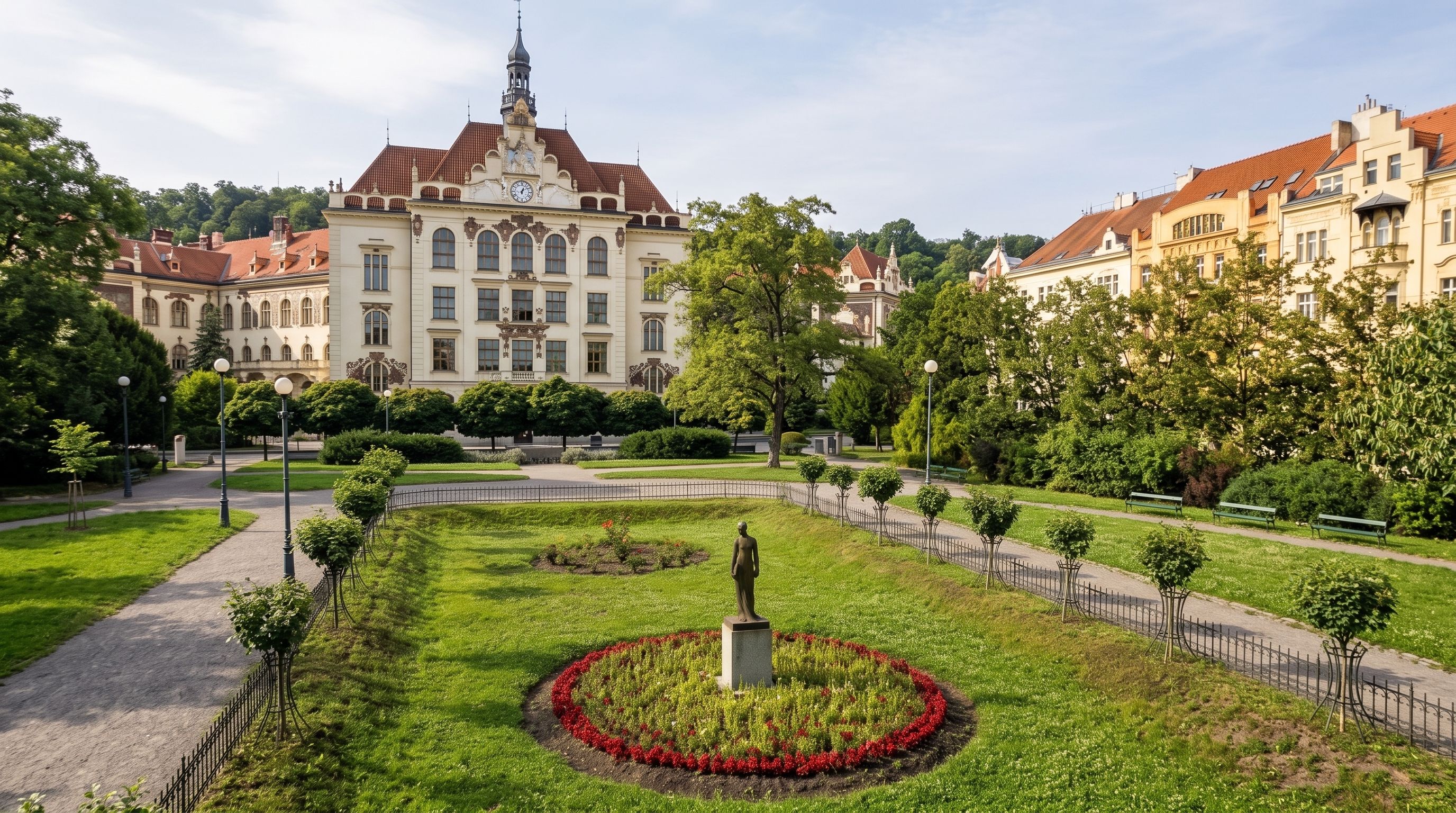
Karlín, the district just east of Prague's centre along the Vltava, was under up to three metres of water in the 2002 flood. Today it is one of the most sought-after places to live in Prague, in our view almost as premium as Vinohrady and much younger and more modern in feel. It is really two neighbourhoods in one: a 19th-century grid of apartment buildings full of cafés and restaurants, and a newer riverside district of offices and new builds. Which of the two you choose changes almost everything about living here.
What it is like to live in Karlín
Karlín is small: about 2.2 km² between the river and the Vítkov hill, all of it in Prague 8. It had 10,532 residents at its low point in 2013 and 14,151 at the end of 2025, an increase of about a third in twelve years, and new projects keep adding more.
The old part was laid out from 1817 as Prague's first planned suburb since the medieval New Town: three long streets (Sokolovská, Křižíkova and Pernerova) crossed by shorter ones, all about 21 metres wide, lined with neo-Renaissance and Art Nouveau apartment buildings. Former factory halls of the ČKD engineering works between them have been turned into offices, lofts and a concert venue. On the ground floors you find cafés, bakeries, restaurants and small shops, so most days you don't need to leave the neighbourhood.
It is also a place where people work. Karlín is one of Prague's five largest office districts, and modern offices here were more than 95% let in 2025. Rohlik Group has its headquarters here, Amazon its Prague corporate office, and companies such as Pipedrive, Expedia Group and Pure Storage (now Everpure) have offices in Karlín, as do the Czech headquarters of Kooperativa and Allianz. On weekday lunchtimes the streets fill with office workers.
That shapes who lives here. In 2020, about one in five Karlín residents was a foreign national, more than the Prague average at the time, and the new riverside buildings in particular have drawn people from Western Europe. Many residents work in English, and in our experience you can get by without Czech in most cafés and shops.
From the 2002 flood to one of Prague's best addresses
In August 2002 the Vltava flooded Karlín, much of it through the sewers rather than over the riverbank. About 25,000 people were evacuated from Karlín and lower Libeň, and around 25 buildings had to be demolished afterwards. The main repairs of streets and municipal buildings took about four years.
The flood also started Karlín's transformation. The first riverside office building was finished in 2003, others followed, and the old factory sites filled with offices and flats. In 2017 the Prague 8 town hall noted that the new office buildings were already worth more than the damage the flood had caused. How well Karlín is protected today is covered below.
The parts of Karlín
In our experience Karlín falls into five areas. The historic core around Křižíkova is what most people mean by "real" Karlín and is its most beautiful part. The riverside new-build district is very different, but just as sought after.
The historic core around Křižíkova
The streets around Karlínské náměstí, with its neo-Romanesque church of St Cyril and Methodius and a park with a playground and fountain, are the heart of Karlín. Křižíkova street and the streets crossing it have the densest mix of cafés, restaurants and bars, the Karlín Musical Theatre, and metro line B at Křižíkova. This is the part with the best-kept 19th-century buildings and the liveliest street life. The catch is that almost everything here is an old building, with everything that comes with it (see the buildings section below).

The riverside: River City and Rohan
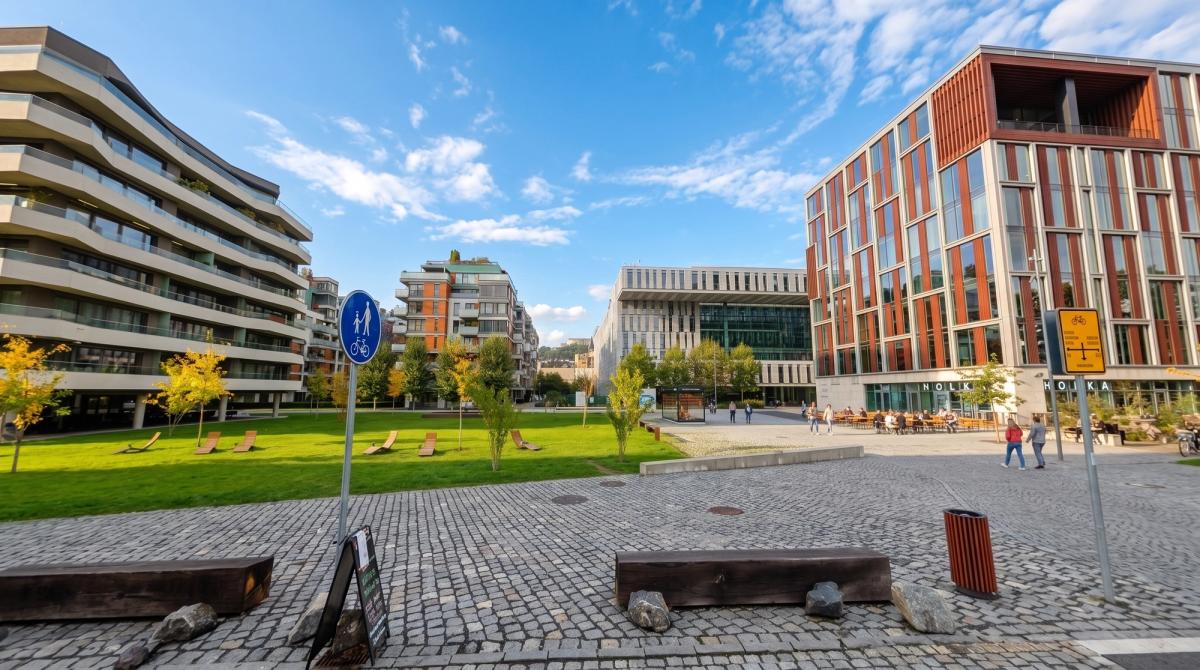
Along Rohanské nábřeží and on the former Rohan island, Karlín looks like a different city: glass office buildings, new apartment blocks, a riverside cycle path and wide green spaces along the water. This is where most new builds are, many with underground parking, lifts and balconies. More is coming: the Rohan City development is adding hundreds of flats over the coming years, and the city is designing a 17-hectare riverside park (Park Maniny), which is not expected to be built before 2030. The trade-offs are a four-lane road along the embankment, construction sites for years to come, and calmer street life than in the old grid.
The western edge at Florenc
The western end of Karlín borders the centre. Florenc has metro lines B and C and Prague's main coach station, and the Negrelli viaduct, a railway bridge from 1850 rebuilt in 2017 to 2020, crosses Karlín here. This is the best-connected part of the district and the noisiest: the north-south highway and the railway on the viaduct both run past. The area is also changing: a large development called Florenc 21 is planned around the coach station by 2031.
Under Vítkov: Pernerova and the barracks
Pernerova street runs along the southern edge under Vítkov hill, next to the railway. It mixes old apartment buildings with converted factory halls, offices and two cultural venues: Forum Karlín, a concert hall for up to 3,000 people, and the former Karlín barracks, whose courtyard hosts a summer cinema and events. A pedestrian tunnel leads from Thámova street under the hill to Žižkov and the park on Vítkov.
The east towards Invalidovna
East of Lyčkovo náměstí, the grid continues towards Invalidovna, a large baroque former military hospital from the 1730s that has been under renovation since August 2026 and should reopen around 2030 with exhibition spaces, a concert hall and public gardens. The streets here are quieter and slightly less polished, with Kaizlovy sady park, metro B at Invalidovna and modern office buildings at the transition to Libeň. Prices are usually a little lower than in the historic core.
If you are weighing a specific street or building in Karlín, send it to us. We can usually tell you straight away what living there is like.
Safety
Karlín is very safe, like practically all of Prague. Crime in Prague fell again in 2025 to its lowest level in 15 years, and the incidents recorded on the police crime map in Karlín went down by about 10% between 2023 and 2025, with a further fall in 2026.
Most of what happens is concentrated around Florenc, where the coach station and the metro bring large crowds: roughly a third of Karlín's recorded incidents and about half of its pickpocketing take place there. Keep an eye on your phone and bag at the station. In the residential streets, the most common problem is theft from parked cars, so don't leave anything visible inside.
Families: schools, nurseries and parks
Karlín has two public primary schools, both with nurseries. The school on Lyčkovo náměstí sits in an Art Nouveau building from 1904 to 1906 and works with the Faculty of Education of Charles University. The school named after Petr Strozzi, on Za Invalidovnou street near Invalidovna, has run Czech-English bilingual classes since 2010, where most subjects are taught in English. There is another public nursery near Invalidovna and a few private bilingual nurseries, and the English College in Prague, an International Baccalaureate school, is a few stops east in Vysočany.
For outdoor space, families use Kaizlovy sady with its playground and pond, the park on Karlínské náměstí, Lyčkovo náměstí, the riverside paths, and Vítkov hill through the pedestrian tunnel. Prague bans drinking alcohol in public within 100 metres of playgrounds, schools and metro entrances, and Prague 8 adds several Karlín squares and parks to that list.
Public primary schools give priority to children from their catchment area, based on the family's registered address, so if a particular school matters to you, check its catchment before choosing a flat.
Noise and nightlife
Noise in Karlín depends mostly on how close you are to its western and riverside edges. The loudest spots are around Florenc, where the north-south highway and the Negrelli viaduct meet, the embankment road along the river, and Sokolovská, the only street in Karlín with trams. The quietest are the streets in the east around Lyčkovo náměstí and Invalidovna. As everywhere in Prague's old districts, a flat facing the courtyard can be very quiet even on a busy street.
Nightlife is real but moderate. The restaurants and bars around Křižíkova stay busy in the evenings, and Forum Karlín, the Karlín Musical Theatre and the barracks bring crowds on event nights. After complaints from neighbours, the summer cinema in the barracks courtyard now runs with headphones only. If you are sensitive to noise, check the city's strategic noise map for the street and visit the flat once in the evening.
Getting around and parking
Karlín has two metro stations of its own on line B, Křižíkova and Invalidovna, and Florenc on its western edge adds line C. From Křižíkova it is three stops to Můstek at the bottom of Wenceslas Square. Trams (lines 3, 8, 12 and 24) run along Sokolovská, the coach station at Florenc has international connections, and a main cycle route follows the river.
All of Karlín lies in Prague's paid parking zones. In 2026 a resident with a registered address pays 1,200 Kč a year for a permit for the first car, and an owner who does not live here pays 7,000 Kč. Commuters add pressure on spaces, especially around Karlínské náměstí. Parking is where the two halves of Karlín differ most: about two thirds of new-build flats for sale in October 2026 came with a parking space, against about one in eight flats in older buildings.
The buildings, and what to check before you buy
The old grid is a heritage conservation zone, declared in 1993. Owners there need a binding opinion from the city's heritage authority before changes to the exterior, which in practice usually means wooden windows that copy the originals, and no air conditioning unit on the street facade without approval from both the heritage authority and the owners' association. Flats with air conditioning are rare in the old buildings, and Prague summers are hot.
Old buildings in Karlín are expensive to maintain, even when they look beautiful and well kept. A restored facade tells you little about the roof, the wooden beam ceilings, the cellars or the risers, and buildings that stood in floodwater in 2002 may have had problems with damp in the walls and beams. Before you buy, read the minutes of the owners' association's recent meetings, check how much is in the repair fund and what repairs are planned, and if the building has had damp problems, ask how they were solved. A low monthly contribution often means the big repairs are still ahead.
In the new riverside buildings, the questions are different: the quality of the developer, the service charges for shared spaces, the price of a parking space if it is sold separately, and whether you are happy to live next to construction sites for a few more years.
In both, check whether flats in the building are rented out short term. In 2023, entire-flat short-term rentals made up 2.8% of Karlín's housing, one of the highest shares outside the historic centre.
Flood risk today
Since 2002 Prague has built flood defences designed for a flood the size of 2002 plus 30 centimetres. Karlín's section, built from 2004 to 2006, is mostly a fixed concrete wall along Rohanské nábřeží, with openings closed by mobile barriers when needed, and an embankment around the riverside district. Because much of the 2002 water came up through the sewers, the city also fitted the sewer network with backflow protection and finished the last stage, a large retention tank, in 2023. More sewer works in Šaldova street are due to finish in 2028.
The defences have been tested. In the 2013 flood, the second largest on record in Prague, the city evacuated 1,279 people and damage came to CZK 4 billion, compared with about 50,000 evacuated and CZK 27 billion of damage in 2002. Ground-floor flats, basements and cellars are still the most exposed, so check the building's flood history and confirm with your insurer that the address can be covered.
What it costs
Karlín is one of the more expensive parts of Prague. In October 2026, new-build flats on the largest Czech property portal were listed at a median of about CZK 259,000 per m² and flats in older buildings at about CZK 210,000 per m², against about CZK 168,000 for Prague as a whole. A typical 2+kk of about 54 m² was listed at around CZK 12.9 million, a 1+kk of about 30 m² at around CZK 7.3 million. Asking rents were about 33,500 Kč a month for a 2+kk and 21,900 Kč for a 1+kk, before utilities.
For the wider picture, see our articles on what a flat costs in Prague in 2026 and average rent by district.
Our take
For investors
Karlín is a good place to own a flat and a modest place to earn from one. On asking prices in October 2026, the gross rental yield in Karlín came to about 3.0%, against about 3.4% for Prague as a whole. Prices per square metre are high, and rents, although among the highest in the city, don't fully keep up.
What you get in return is liquidity. In our experience a flat in Karlín sells as easily as one in Vinohrady, as long as the price is right. The new riverside buildings add something the old Prague districts rarely offer: a flat with its own parking space, which tenants and later buyers both value. In the old grid, budget for repairs and read the owners' association documents carefully before you commit. As anywhere, we would stay at or below about 60 m² and buy only when we were sure about both the price and the building.
For people who want to live there
Karlín suits people who want a modern, walkable city life: work, restaurants, the river and the metro within a few minutes, in a district that feels younger than the rest of central Prague. It works especially well if you work in Karlín itself or commute by metro, and it is one of the easiest parts of Prague to live in without speaking Czech.
The first decision is which Karlín you want. The historic core gives you the beautiful streets and the cafés, with old-building quirks and little parking. The riverside gives you a new flat with a lift, a balcony and a parking space, in a district that is still being built. Compared with Vinohrady, Karlín is a little less established and a lot more modern, and for many people that is exactly the point.
If you have any questions about Karlín, a particular building or buying a flat here, get in touch. We are happy to help.