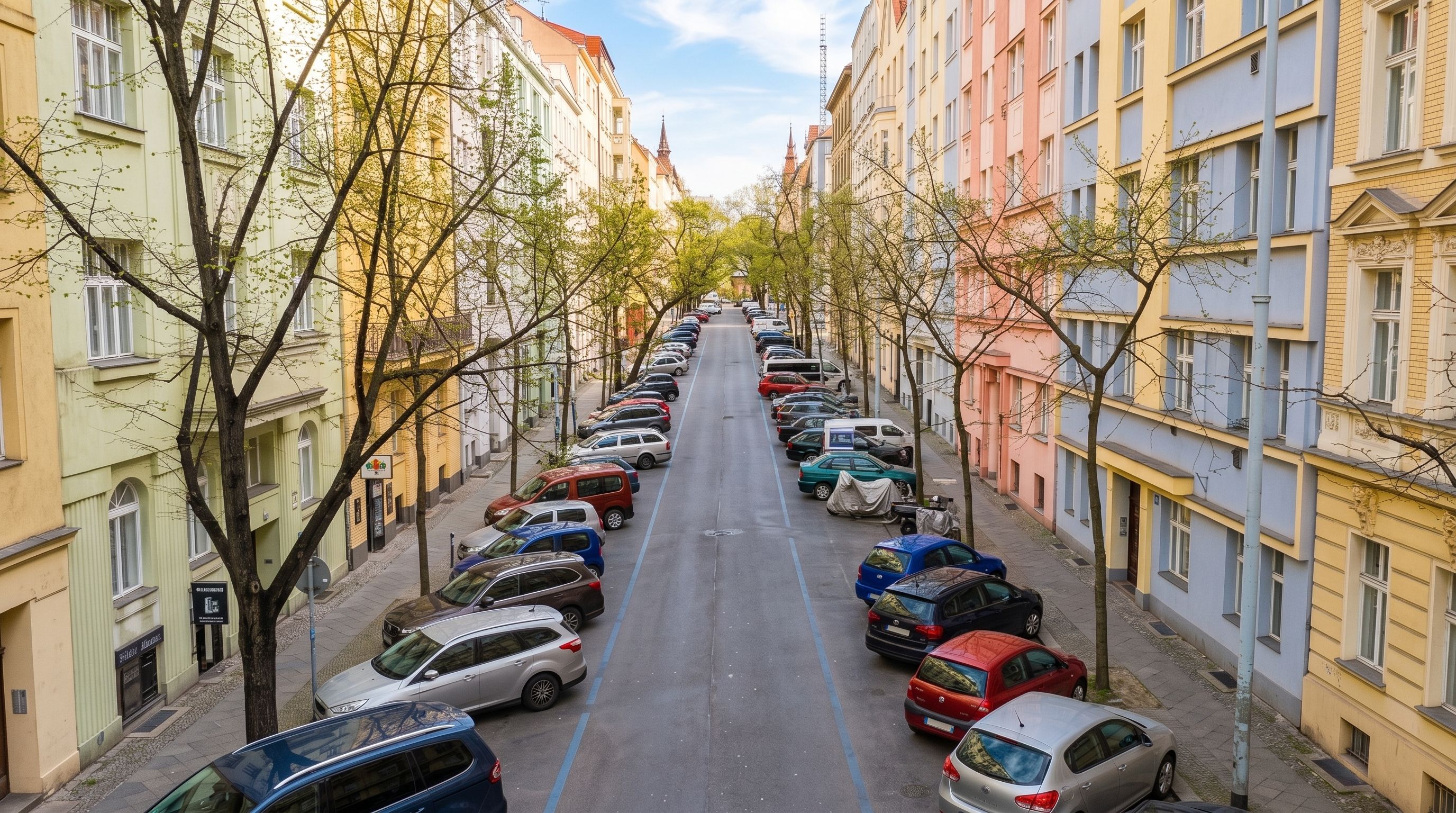
Vinohrady is a residential quarter of late 19th and early 20th century apartment buildings directly east of Prague's centre, and in our view probably the most premium residential address in the Czech Republic. It suits people who want cafés, parks and the metro a few minutes' walk from home. The trade-offs are old buildings that need care, little parking and some of the highest prices in the city. The quarter is far from uniform, though: a flat by Náměstí Míru, one near the main railway station and one past Flora are three different places to live.
What it is like to live in Vinohrady
Vinohrady covers 3.79 km² and had 48,805 residents at the 2021 census, which makes it one of the most densely populated parts of Prague. Almost all of it was built from the 1870s to the 1930s as blocks of apartment buildings around shared courtyards, on a grid of tree-lined streets. The ground floors hold bakeries, cafés, small shops, pharmacies and doctors' practices, so most errands are a walk of a few minutes.
It is also one of the most beautiful parts of Prague. Whole streets of ornate facades from around 1900, neo-Renaissance, Art Nouveau and later functionalist, have survived almost intact, with decorated entrance halls and stairwells behind them and rows of trees in front. Most of the quarter lies in an urban conservation zone declared in 1993, which is one reason it still looks the way it does.
It is a lived-in quarter rather than a tourist one. The people on the street are mostly residents: families, older Praguers who have lived here for decades, students and a large international community, which is why you will hear a lot of English in the cafés. In the evenings, the bars around Náměstí Jiřího z Poděbrad and the park at Riegrovy sady fill up, while most side streets go quiet.
The parts of Vinohrady
Since 1960 Vinohrady has been split between five city districts, more than any other part of Prague. About 55% of it lies in Prague 2, the north-eastern part belongs to Prague 3, a south-eastern part to Prague 10, and small edges to Prague 1 and Prague 4. Listings use the district, not the quarter, so a "Prague 3" flat can be in Vinohrady or in neighbouring Žižkov, and a "Prague 10" flat in Vinohrady or Vršovice.
In our experience the quarter falls into five areas. Praguers see the streets around Náměstí Míru and Jiřího z Poděbrad as the "real" Vinohrady. The area around Flora is technically still Vinohrady, but it is not as premium.
Around Náměstí Míru
The square with the church of St Ludmila and the Vinohrady Theatre is the centre of the quarter and its main transport hub, with metro line A and several tram lines. The streets around it have the grandest buildings and the busiest shops. It is the most convenient part of Vinohrady and among the most expensive. Main streets such as Vinohradská and Korunní carry trams, so the side streets are quieter.
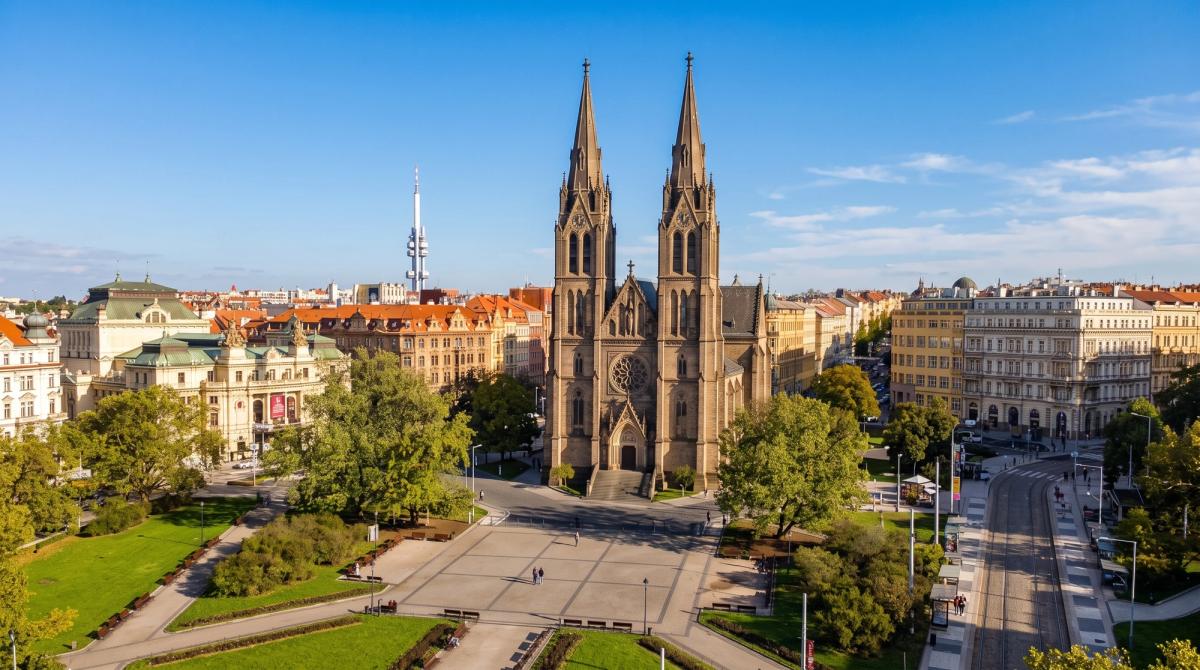
The western edge: Riegrovy sady, the main station and I.P. Pavlova
This is the part closest to the centre: Wenceslas Square and the New Town are a short walk away, and the main railway station is next door. Riegrovy sady, a hillside park with a view across the city to Prague Castle, is the local favourite on summer evenings. The catch is noise. The north-south highway runs along this edge, the area around I.P. Pavlova has bars open late, and the park's beer garden is busy on warm nights. Concerts at the beer garden now end at 9 p.m.
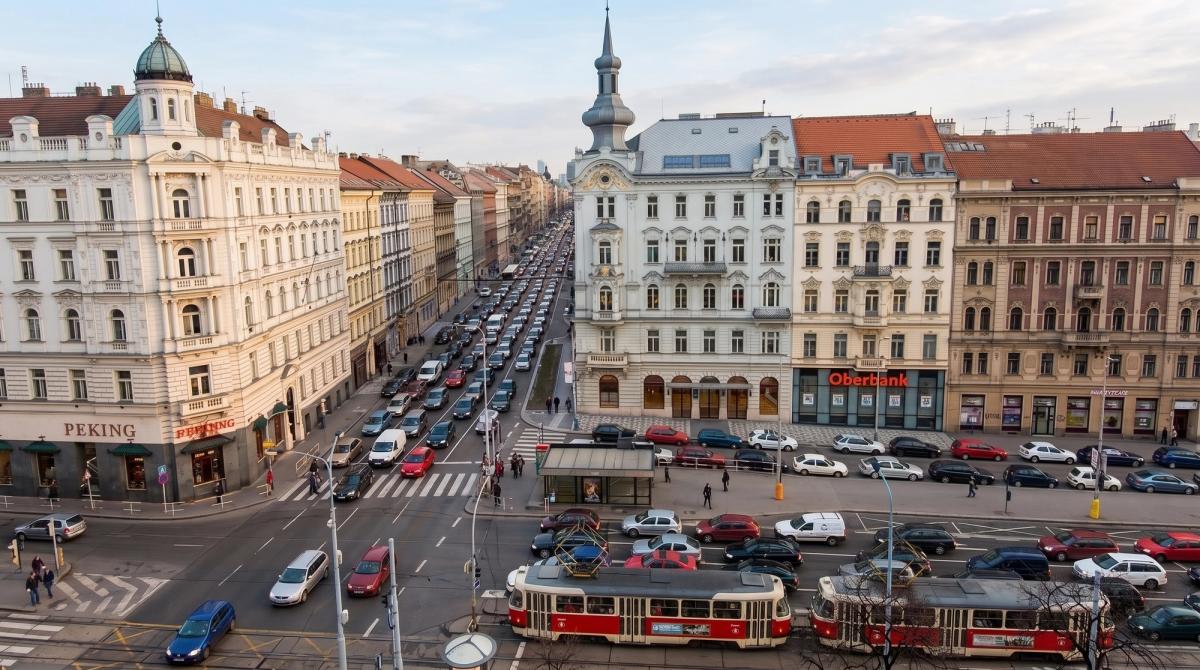
Jiřího z Poděbrad (Prague 3)
The square at Jiřího z Poděbrad, with its modernist church by the architect Jože Plečnik, is the second heart of the quarter. It has its own metro station, a regular farmers' market and the densest cluster of cafés, restaurants and bars in Vinohrady, so evenings around the square are lively. Together with Náměstí Míru, this is the most sought-after part of Vinohrady, and the streets between the two squares are where demand is strongest.
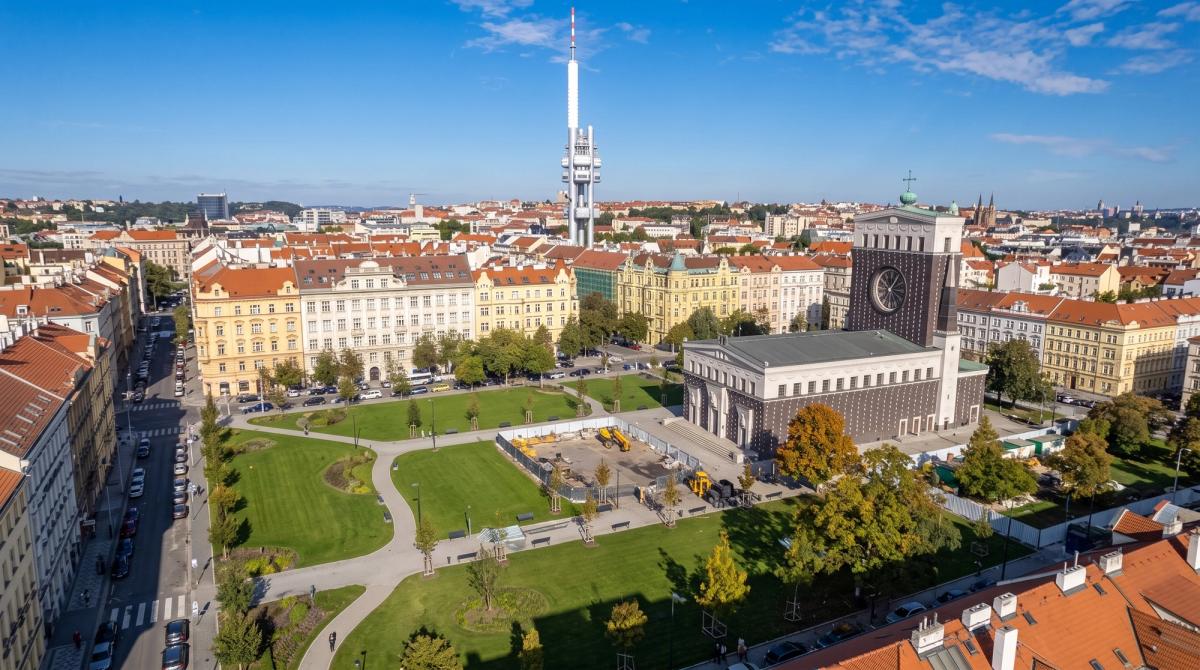
The south around Havlíčkovy sady
Havlíčkovy sady, also called Grébovka, is a park on a slope with a working vineyard. The streets around it and around the southern part of Prague 2 are among the quietest in Vinohrady, with some villas among the apartment buildings. The trade-off is distance: you are further from the metro, and some streets are steep.
Flora and the east (Prague 3 and Prague 10)
Around Flora, with its large shopping centre and metro station, and further east and south towards the large teaching hospital in Prague 10, the quarter changes. It is technically still Vinohrady, but the streets are less grand, the main roads busier and prices usually lower than around the two main squares. It is the most purely residential and practical part, with trams along Vinohradská and the metro at Flora or Želivského within walking distance.
Safety
Vinohrady is very safe, as is practically all of Prague. You can walk home at any hour, and families with children live here without a second thought. Crime in Prague keeps falling: in 2025 the police recorded the lowest number of crimes in the city in 15 years. The most common problem, here as anywhere in the city, is petty theft, so lock your bicycle and keep an eye on your phone on a crowded tram.
If you are unsure about a particular street, get in touch. We can usually tell you about the micro-location straight away.
Families: schools, nurseries and parks
Prague 2 alone has about 20 primary schools, most of them public, and around 18 nurseries (mateřské školy). Public primary schools admit children by catchment area (spádová oblast) based on the family's registered address, and children from the age of three get priority at the nursery for their catchment. If a particular school matters to you, check its catchment map before you choose a street.
For outdoor space, families use Riegrovy sady, Havlíčkovy sady and the playgrounds on the squares. In late 2025 Prague 2 announced plans to rebuild the playground at Riegrovy sady for an estimated CZK 30 million. Prague 2 also bans drinking alcohol in public on Náměstí Míru and within 100 metres of playgrounds, schools and metro stations.
The harder part for families is the housing itself. Larger flats exist, but many are on upper floors of buildings without a lift, and balconies or private outdoor space are rare. Families with a pram should check the lift and the stairs as carefully as the flat.
Noise and nightlife
Noise in Vinohrady depends on the street and on which side of the building the flat faces. The loud spots are the north-south highway on the western edge, the tram streets (Vinohradská and Korunní above all), the bars around I.P. Pavlova and Jiřího z Poděbrad, and Riegrovy sady on summer evenings. A flat facing the courtyard in the same building can be very quiet.
The city publishes a free strategic noise map (2025 edition) that shows daytime and night-time traffic noise street by street. It is worth checking before a viewing, and worth visiting the flat once in the evening too.
Getting around and parking
Metro line A runs the length of Vinohrady, with stations at Náměstí Míru, Jiřího z Poděbrad and Flora. From Náměstí Míru it is one stop to Muzeum at the top of Wenceslas Square, or about ten minutes on foot. Trams cover the main streets, and the main railway station is on the western edge.
Parking takes some planning, but it is possible. Vinohrady lies entirely inside Prague's paid parking zones. In 2026 a resident with a registered address in the district pays 1,200 Kč a year for a permit for the first car and 7,000 Kč for a second, and an owner who does not live there pays 7,000 Kč for the first car. A permit does not guarantee a space right outside your building, especially in the evening, and flats with a garage space are rare.
The buildings, and what to check before you buy
Most flats in Vinohrady are in buildings over a hundred years old: high ceilings, large windows, wooden floors, courtyards, and often no lift or one added later into the stairwell. They age well when the owners look after them and badly when they do not. Before you buy, check:
- The repair fund and the minutes of the owners' meetings. Roofs, facades, risers and lifts are expensive, and the owners pay for them. A low monthly contribution can mean the big repairs are still ahead. Our list of documents to request when buying a flat in Prague covers what to ask the building for.
- That the flat is legally a flat. Attic conversions and ground-floor units are sometimes registered as non-residential space, such as a studio or an office, which can complicate a mortgage and a later sale. Check the land registry entry and the building approval (kolaudace).
- Air conditioning. Flats with air conditioning are still rare in Vinohrady, and adding it is difficult: an outdoor unit usually needs the consent of the owners' association, and because most of the quarter is a conservation zone, changes to the facade also need approval from the heritage authorities. Prague summers get hot, top-floor and attic flats most of all, so if you need cooling, ask about it before you buy.
- Which way the flat faces. Courtyard or street makes a bigger difference to daily life here than one floor up or down.
- The layout. Many original 2+1 and 3+1 flats with a separate kitchen have been converted into 2+kk or 3+kk; see our explainer on Czech layout codes if these are new to you.
What it costs
Flats in Prague 2 sold for an average of CZK 199,900 per m² in the first half of 2026, based on purchase contracts recorded in the land registry, up 9.0% on the second half of 2025. Only Prague 1 was more expensive. At that average, a 55 m² 2+kk comes to about CZK 11 million. Asking rents in Prague 2 averaged 482 Kč per m² a month in the second quarter of 2026, about 26,500 Kč for the same flat before utilities. The Prague 3 and Prague 10 parts of Vinohrady are usually a little cheaper than Prague 2.
For the full picture, see our articles on what a flat costs in Prague in 2026 and average rent by district.
Our take
For investors
Vinohrady is the most stable and most premium residential area in Prague, and the price of that is a low return. As a model example, a 2+kk bought and let at Prague 2 averages earns a gross yield of about 2.9%, against about 3.5% at Prague 10 averages. What you get in exchange is demand: flats here let quickly, sell to a wide pool of buyers, and in our experience hold their value better than almost anywhere else when the market turns.
We advise investors to stay at or below about 60 m², to prefer the streets around Náměstí Míru and Jiřího z Poděbrad over the edges when the budget allows, and to buy only when they are certain the price is right.
For people who want to live there
Vinohrady suits people who want a city life on foot: beautiful streets, the metro, a park and a good bakery within a few minutes, and a short walk or ride into the centre. It works for families with young children who are fine with an older building and stairs.
It suits less well if you need air conditioning, a new building with a lift and a balcony, or the most space for your money. Newer parts of Prague 8, 9 or 10 give you more for the same budget. If you drive every day, look for a flat with a garage space or expect to spend a few minutes finding a spot in the evening.
For a home, fit matters more than the last few percent of the price, but here the building matters as much as the flat. Read the minutes of the owners' meetings and check the repair fund before you commit.