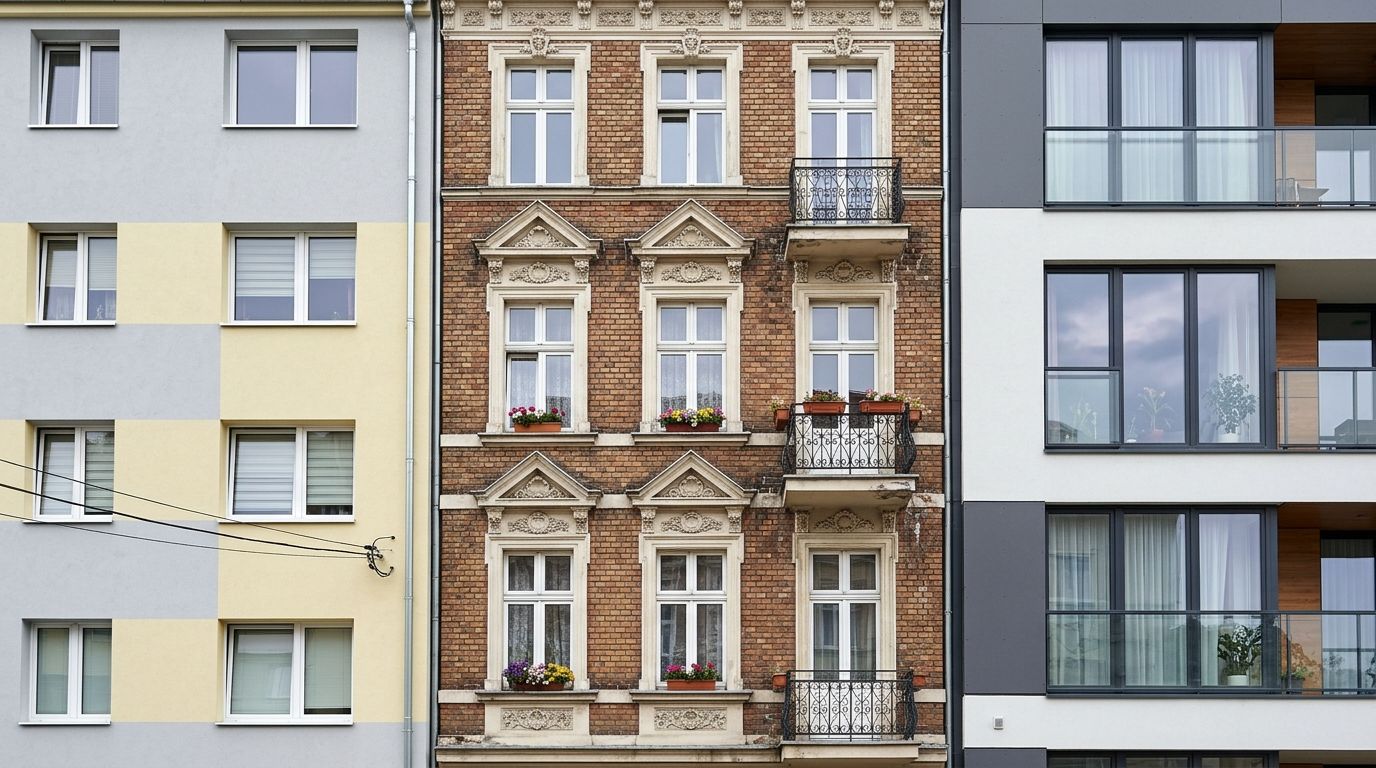
The type of building, whether a new build, an older brick building or a panel block, mostly tells you what a Prague flat will cost. Whether the flat is a good buy depends on the specific building. A renovated panel block with a well-run owners' association is often a better purchase than a handsome old tenement where nothing has been repaired in twenty years, and a new build does not mean you will never have to deal with anything.
The price gaps are large. At the end of October 2026, flats in Prague new builds were advertised at a median of about CZK 187,500 per m² (roughly €7,700), flats in older brick buildings at CZK 169,100 (€6,950) and flats in panel buildings at CZK 134,600 (€5,540). A panel flat costs about 28 % less per square metre than a new one and about 20 % less than one in a brick building.
The three types, explained
Czech listings sort flats by what the building is made of and how old it is. Three categories cover almost the whole Prague market:
- A new build (novostavba) is a flat in a building that is brand new or still under construction, usually bought from a developer.
- A brick building (cihlový dům, often shortened to "cihla") is any older masonry building. In Prague that ranges from 19th-century tenements (činžáky) with high ceilings to brick buildings from the 1990s and early 2000s.
- A panel building (panelák) is a block built from prefabricated concrete panels, mostly between the 1960s and the early 1990s, typically on the housing estates (sídliště) around the city.
If you come from a country where post-war concrete blocks are social housing, the panelák needs some context. In the Czech Republic it is ordinary housing. About three million Czechs live in panel buildings, flats in them are bought and sold like any others, and many Prague estates have good schools, parks and metro stations.
Prices and rents by building type (October 2026)
On 28 October 2026 we went through Prague listings on the largest Czech property portal: 5,093 flats for sale and 3,063 flats for rent, all with a full price. Here is how the three types compare (euro figures at about CZK 24.3 per euro):
- New builds: median CZK 187,500 per m². The typical flat has 60 m² and costs CZK 11.5 million (€473,000). Median rent CZK 525 per m² a month, gross yield about 3.4 % a year.
- Older brick buildings: median CZK 169,100 per m². The typical flat has 61 m² and costs about CZK 10 million (€411,000). Rent CZK 474 per m², gross yield about 3.4 %.
- Panel buildings: median CZK 134,600 per m². The typical flat has 65 m² and costs CZK 8.3 million (€342,000). Rent CZK 427 per m², gross yield about 3.8 %.
A 2+kk (a living room with a kitchen corner plus one bedroom; our explainer of Czech layout codes covers the rest) shows the difference most clearly:
- New build: 52 m², CZK 9.5 million (€391,000), rents for CZK 27,500 (€1,130) a month.
- Brick building: 51 m², CZK 8.9 million (€366,000), rents for CZK 25,000 (€1,030).
- Panel building: 44 m², CZK 6.8 million (€280,000), rents for CZK 20,000 (€820).
The gap widens with size. A new three-bedroom 3+kk of 80 m² has a median asking price of CZK 14 million (€576,000). A panel 3+1 of 72 m², with a separate kitchen, costs CZK 8.75 million (€360,000).
The gap holds within the same district
Part of the difference is location: there are almost no panel buildings in central Prague. Only 2 % of advertised panel flats are in Prague 1, 2, 3 or 7, against a third of brick-building flats. But the gap stays when you compare flats in the same part of the city. In Prague 4, the median asking price was CZK 186,000 per m² in new builds, CZK 160,000 in older brick buildings and CZK 135,000 in panel buildings. In Prague 8 it was 191,000, 161,000 and 135,000.
Rents are a different story. In Prague 4, a panel flat rented for CZK 431 per m² a month and a brick-building flat for CZK 438. In Prague 8 it was 430 against 448. Tenants pay roughly the same per square metre for both, while buyers pay about a sixth less for the panel flat.
Actual sale prices recorded in the land registry point the same way. In the first half of 2026, panel flats in Prague sold for about CZK 132,000 per m², while flats in brick buildings and in developer projects both sold for about CZK 157,000. Panel flats have also been rising faster: across the Czech Republic they gained 14 % in 2025, against 10 % for brick-building flats. Nobody knows whether that lasts. If higher mortgage rates push buyers to focus on the total price, demand for panel flats may keep growing. The gap could just as easily stay where it is now.
New builds: the highest price, the fewest worries at the start
A new flat costs the most per square metre, but you get a building that should not need major money spent on it for years. New buildings are usually energy class A or B, so running costs are low, and some Czech banks take 0.1 to 0.2 percentage points off the mortgage rate for such a flat. Layouts suit how people live today, and there is a lift and often an underground garage.
What to watch out for:
- Check the developer thoroughly. Many smaller, inexperienced developers have entered the market in recent years, and buyers end up paying for their mistakes: construction defects, or delays of whole years. Look at what the developer has already built, walk around its finished buildings and ask the owners there how handover and complaints went. Projects are often built by a newly founded project company, so find out who stands behind it and check it in the Czech commercial and insolvency registers. Ask how your deposits are protected, for example whether payments go into escrow.
- Parking costs extra. The median price of a garage parking space in Prague was about CZK 690,000 (€28,000) in September 2026, and some projects require you to buy one with a larger flat.
- Defects at handover are common. Bring a building inspector to the handover and have every defect written into the handover report. Hidden defects that show up later can be claimed for up to five years from handover, but always without undue delay once you find them.
- Small flats are expensive. A new 1+kk (studio) has a median of 33 m² and costs CZK 6.9 million (€284,000), the highest price per m² of any layout.
- The neighbourhood may not be finished. Shops, a nursery or mature trees often arrive years after the building is approved for use.
Why new-build prices keep rising even with a record number of flats on offer is the subject of our article on Prague's new-build market in Q3 2026.
Older brick buildings: the best locations and the widest differences between buildings
Brick buildings stand in Prague's most sought-after areas and have the best transport. 68 % of advertised brick-building flats are within a kilometre of a metro station, against 51 % of new builds and 47 % of panel flats. Flats in old tenements have high ceilings, thick walls and layouts nobody builds any more, and they sell and rent easily.
No other type varies as much from building to building. A 1930s building with a new roof, new wiring and a lift and a building of the same age where only the façade got a coat of paint can look much the same in a listing, and cost their owners very different sums over the next ten years.
What to check in an older brick building:
- Ceilings. Old buildings often have wooden beam ceilings. Sagging, cracks or damp can mean dry rot, which is expensive to treat and concerns the whole building.
- Pipes and wiring. Original electrics, water pipes and drains were often replaced only inside some flats. Ask what has been replaced in the shared parts.
- Roof, façade, cellars. A major repair is paid from the building's repair fund, and if there is not enough in it, through extra contributions from owners or a loan.
- Heritage zone. Much of central Prague is protected. There, façades usually cannot be insulated from the outside, and new windows or an outdoor air-conditioning unit need the heritage authority's approval. Air conditioning is rare in old buildings, and top-floor flats under the roof get hot in summer.
- Energy. An uninsulated tenement usually has a worse energy class, so heating bills are higher than in a new build.
Brick buildings from the 1990s and later usually have fewer of these problems and sit between an old tenement and a new build on price.
Panel buildings: the most space for the money, if the building has been renovated
The idea that panel buildings only last 30 to 50 years is out of date. Structural engineers who study them now expect a lifespan of a hundred years or more with proper maintenance.
The main advantage is space at a reasonable price. A family that needs three bedrooms can buy a panel 3+1 of 72 m² in Prague for a median CZK 8.75 million (€360,000). A new 3+kk of 80 m² costs about CZK 14 million. Panel flats tend to have a separate kitchen, a cellar storage room and a loggia.
With a panel building, the main question is whether, and how well, it has been renovated:
- Renovation. Insulation, new windows, roof, loggias, lifts and the vertical water and drainage pipes. A building that has already done and paid for this work is a much better buy than one that still has it ahead.
- Quality of the first round. Many buildings were insulated cheaply and in a hurry, and some now have damp, mould on north-facing walls or failing loggias. A lot of buildings face a second round of repairs, so "insulated" in a listing is not enough. Ask when and how it was done.
- The bathroom core. Many panel flats still have the original prefabricated bathroom and toilet unit (the umakart core, made of laminate panels), which means a full bathroom renovation. In older buildings the vertical pipes can contain asbestos, and replacing them has to be done by specialists.
- Noise. Sound travels between flats more than in brick buildings. Stand in the stairwell during a viewing and listen.
- Ownership. Some panel flats are still co-operative flats (družstevní byty), which you buy as a membership share, not as property. We explain the difference in družstvo vs. osobní vlastnictví.
What to check in any building
These questions apply to every flat, new builds included:
- Minutes of the owners' association meetings (SVJ) for the last two or three years. They show what is being repaired, what keeps being postponed and whether the owners can agree on anything.
- The repair fund: the monthly contribution, the balance and the repair plan. A low contribution can mean a building that is already in good shape or one that keeps putting repairs off. The number means little until you know what it is saved for.
- Any loan taken by the association or co-operative: how much is left and how much falls on the flat you are buying.
- What has been repaired and when: roof, façade, windows, pipes, wiring, lift.
- The energy performance certificate (PENB), which the seller has to show you. The class tells you roughly what you will pay for energy.
- The shared spaces. The cellar, attic, stairwells and roof say more about how a building is looked after than a renovated flat does.
There is currently no obligation for flat owners in the Czech Republic to renovate. The Czech bill that brings the new EU buildings rules into law does not impose any blanket obligations on owners of flats, according to the Ministry of Industry in September 2026. Our list of documents to request when buying in Prague covers the paperwork in more detail.
Our take
For investors
We think a panel flat is a good investment if the building has been renovated and the flat is close to the metro. It rents for almost the same per square metre as a brick-building flat, costs a sixth to a fifth less to buy, and so has the highest gross yield of the three types, about 3.8 % a year in October 2026 before costs and tax. Small and mid-sized panel flats also sell without trouble in Prague. An unrenovated building with big repairs ahead is a different case: extra repair-fund contributions can eat part of the return for years.
An older brick-building flat in a good location holds its value most steadily, but the yield is lower and the building needs very careful checking. A new build makes sense where the price per m² is not far above older buildings nearby. Whatever the building, we would not go above a 2+kk, or about 60 m², for an investment. And for older buildings, work out the return with the repairs the building faces in the coming years, not just from today's price and today's rent.
If you want to live there
Here the type of building is mostly about what you want from your home. A family that needs space and does not want to pay CZK 14 million will most likely find it in a panel building. If you want to live near the centre under high ceilings, you will choose a brick building, but expect to renovate and choose the building more carefully than the flat. If you do not want to deal with anything and have the budget, you will go for a new build, check the developer thoroughly and inspect the flat carefully at handover.
Whichever you pick, walk through the whole building and the street around it before you buy, not just the flat. Talk to the neighbours. Ten minutes with them will tell you more about the building than the listing.