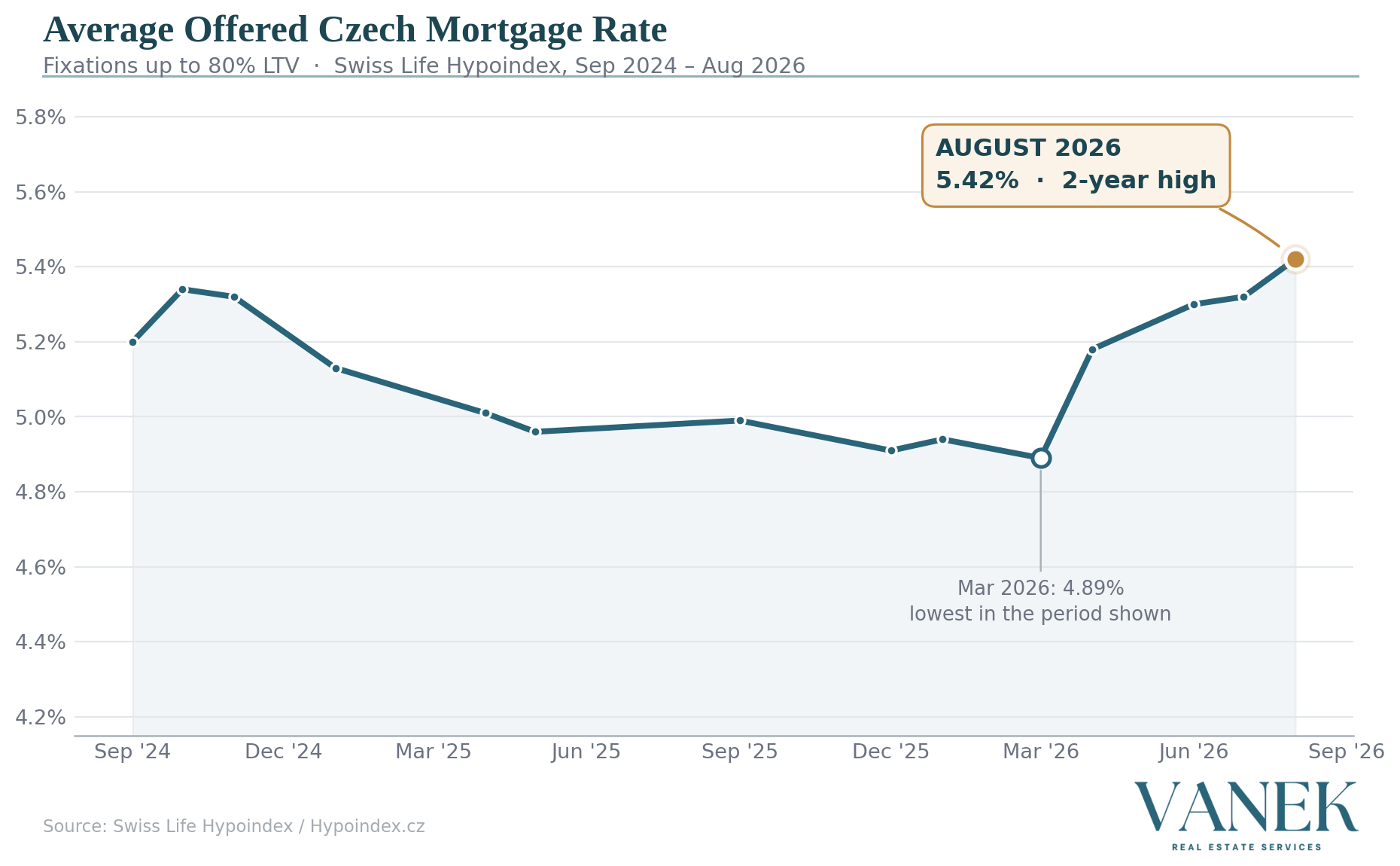
The average offered mortgage rate in the Czech Republic climbed to 5.42% in August 2026, the highest in two years. Foreigners can still borrow from Czech banks, and non-residents typically pay 0.3 to 1 percentage point above the standard rate, which puts realistic offers between roughly 5.7% and 6.4%. Whether that kills the deal depends on math, not mood, so here are the numbers.
Where Czech rates stand in August 2026
The cheapest loans are those below 80% of the property value: three-year fixations average 5.17%, one-year 5.18%, and five-year 5.41%. Ten-year fixations are the most expensive at 5.93%. Banks have been repricing unevenly over the summer, with some adding up to 0.4 percentage points while others held still, so two offers for the same loan can differ by tens of thousands of crowns a year.
For scale: a CZK 4 million mortgage over 30 years costs CZK 22,511 a month at the average rate.
What changes when the buyer is foreign
There are no ownership restrictions. Foreigners, including non-EU citizens, buy property in the Czech Republic under the same rules as locals. The differences show up at the bank: non-residents usually pay the 0.3 to 1 point surcharge mentioned above, face stricter income documentation, and are often offered a lower maximum LTV, so plan for more equity than the 20% a local would bring. Buyers with Czech residency and local income get terms close to what locals see.
If your income is in euros or dollars, ask each bank how it discounts foreign-currency income; the treatment differs and it moves the amount you can borrow.
More flats on the market than at any time in seven years
Supply is the quieter story of 2026. Active apartment listings are up about 10% year on year, roughly 29,700 across the country in July, the highest level in seven years of tracking, and a Prague listing now sits on the market for about three months on average.
What that means in practice: more listings mean more sellers in a hurry and more ads that have gone stale, and that is where negotiation room appears. It is not universal, well-priced flats in good locations still go fast. But a buyer who watches the market closely and can spot a listing that has been sitting too long sometimes has the upper hand this year.
Waiting for cheaper money versus buying now
Analysts read the current rate level as close to the peak, with stagnation and then a slow decline as the likely path rather than a quick drop.
On prices, the honest answer is: nobody knows. Asking prices are still rising, but the pace has clearly cooled since spring. Year-on-year growth for older apartments slowed from 16 to 18% last year to about 13% in the second quarter, and the market as a whole is calming down. What autumn and winter bring is anyone's guess. We consider an outright price drop unlikely, but stagnation is entirely possible.
To see how the math works if growth continued: a CZK 10 million flat gaining 6% would cost CZK 600,000 more a year from now, while saving half a point on a CZK 7 million loan is worth about CZK 35,000 a year. In that scenario, waiting for rates costs far more than it saves. Treat this as a model example, not a prediction. If prices stagnate instead, the numbers come out much more even and waiting hurts far less.
Our take: we advise most of our investors to assess every purchase very carefully and to buy only when we are genuinely certain it is a good deal. We would rather let ten opportunities pass than overpay once, because at today's rates every pricing mistake compounds. Buying a home to live in is a different calculation. You need a place now, you are choosing it for years ahead, and whether it fits your life matters more than the last few percent of the price.
How to buy sensibly at these rates
Get a pre-approval before viewing so you know your ceiling. Compare at least three banks; the summer repricing has spread the market apart, and the difference between offers is real money. And treat the purchase price as the biggest lever: at today's rates, every CZK 100,000 of overpayment costs roughly another CZK 100,000 in interest over 30 years. A negotiated discount is worth double this year, and as the supply numbers above show, the market offers more chances to get one than in recent years.
If you are new to the Czech market, our guide on whether foreigners can buy property in Prague covers the legal basics.